
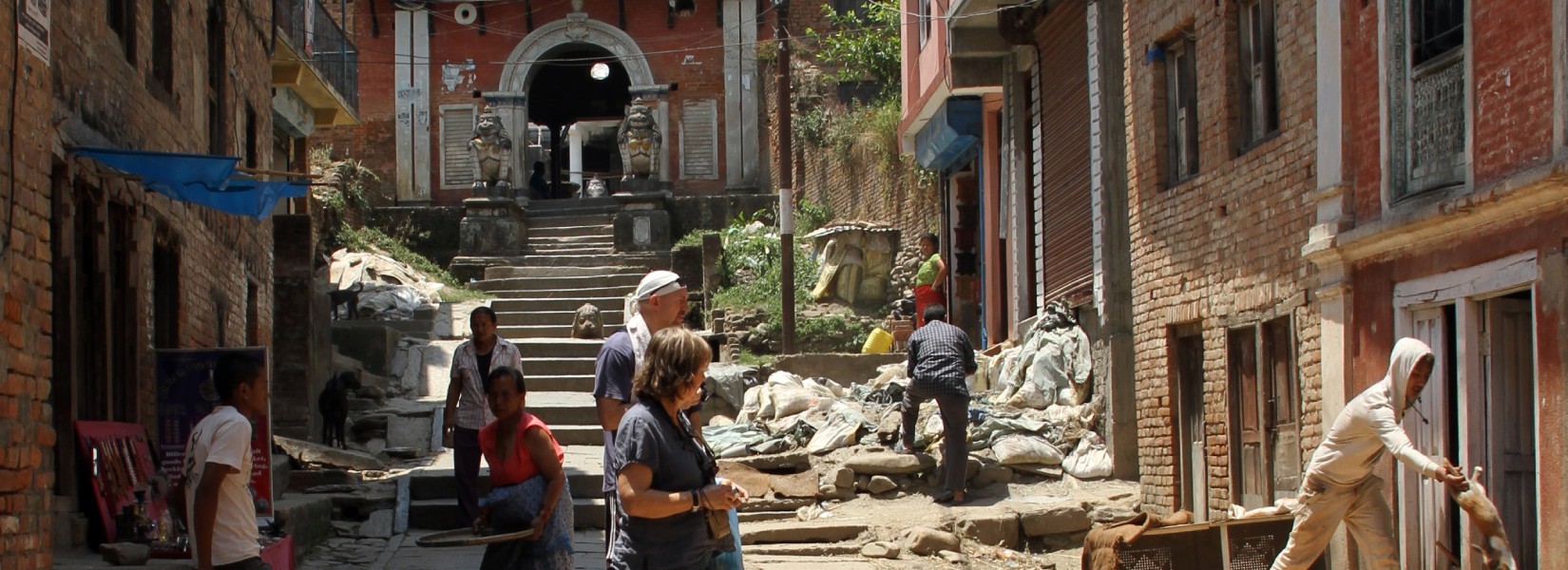
The settlement of Bungamati, perched on a strategic spur of land overlooking the Bagmati River at the southern edge of the Kathmandu Valley, represents one of the most profound examples of Newar urbanism and intangible cultural heritage in Nepal. As a traditional township within the Lalitpur Metropolitan City, its history is not merely a record of dates and dynasties but a living narrative of the Kathmandu Valley’s religious, architectural, and artisanal evolution.
Table of Contents
Plan your trip to Nepal
Customize your trip with help from a local travel specialist.
For over fifteen centuries, Bungamati has served as a crucible for the synthesis of Hindu and Buddhist traditions, centered primarily on the cult of the rain deity Rato Machindranath and a hereditary mastery of woodcarving. This analysis provides an exhaustive examination of Bungamati’s historical foundations, the ritual hydrology of its primary deity, its unique spiritual topography, and the complex socio-economic challenges faced during the post-seismic reconstruction era following the 2015 Gorkha earthquake.
Historical Foundations and Etymological Evolution
The temporal depth of Bungamati is anchored in epigraphic evidence dating back to the early 7th century, a period characterizing the golden era of Licchavi art and architecture. A stone stele attributed to King Amshuverma, dated 605 AD, provides the earliest formalized record of the settlement under the name "Bugayumigrama". The linguistic structure of "Bugayumigrama" suggests a pre-Licchavi, Kirat origin, pointing toward a settlement pattern that predates the Christian Era. Etymologically, "Buga" refers to water resources or springs, "Yumi" is identified as a Kirat Goddess, and "Grama" denotes a village, establishing a primordial link between the site’s identity and sacred hydrology.
Throughout the centuries, the town’s nomenclature has shifted in alignment with political and religious transitions. During the medieval Malla regime, the settlement was known as "Bungapattan," reflecting its status as a significant urban center (pattan). In religious and mythical texts, the village is frequently addressed as "Amarapur" or "Amaravatipur," the "City of Immortals," a title that underscores its sanctity as a pilgrimage site. Mythical accounts, such as those found in the Swayambhu Purana, suggest the existence of a kingdom named "Bandhumati" in the vicinity of the lake that once filled the Kathmandu Valley, which historians posit evolved into the modern name "Bungamati".
| Historical Period | Nomenclature | Key Characteristics |
|---|---|---|
| Kirat Period | Bugayumi | Ancient settlement near water resources; Kirat goddess worship. |
| Licchavi Dynasty | Bugayumigrama | Formalized village; earliest inscriptions (605 AD); agricultural focus. |
| Malla Era | Bungapattan | Development as a religious center; construction of Malla-style monuments. |
| Shah / Modern Era | Bungamati | Center for woodcarving; focus of international reconstruction efforts. |
The original settlement of Bungamati was reportedly situated uphill in an area now referred to as "Bugal" or the Chunikhel region. The relocation to its current site is mythologically linked to the arrival of Rato Machindranath in the valley. The present location was initially a cremation ground surrounded by dense forest, but the construction of the deity’s temple necessitated the movement of the population to the current plateau, creating the traditional Newar layout of narrow alleys and open courtyards seen today.
Rato Machindranath: Ritual Hydrology and Syncretism
The spiritual and social life of Bungamati is inextricably tethered to the deity Rato Machindranath, known locally as "Bungadeya". Machindranath is a quintessential symbol of the Kathmandu Valley’s religious syncretism, serving as a focal point for both Hindu and Buddhist devotion. To the Newar Buddhist community, he is Karunamaya, an embodiment of the Bodhisattva Avalokiteshvara, specifically Rakta Padmapani Lokeshvara, the "Compassionate One". For Hindus, he is identified as Matsyendranath, the legendary yogi and teacher of Guru Gorakhnath, often viewed as a manifestation of Shiva.

The establishment of the Machindranath cult is rooted in a narrative of ecological catastrophe and divine salvation. According to legend, the Kathmandu Valley suffered a devastating twelve-year drought during the reign of King Narendra Deva (c. 640–683 AD). The calamity was attributed to the anger of Guru Gorakhnath, who, feeling unrecognized by the valley’s residents, captured the nine great Nāgas (serpent deities) that governed rainfall and sat upon them in deep meditation at Mrigasthali.
To restore the hydrological cycle, King Narendra Deva of Bhaktapur, the Tantric priest Bandhudatta of Kathmandu, and a farmer named Lalit Jyapu of Patan embarked on a perilous mission to Kamaru Kamakhya (Assam, India) to bring Machindranath to the valley. As the teacher of Gorakhnath, Machindranath’s presence compelled the Guru to rise and pay homage, thereby releasing the Nāgas and triggering the return of the monsoon rains. The deity was brought into the valley in the form of a black bee and subsequently enshrined in Bungamati, which became his first home.
The Dual Residence and the Annual Jatra
Unlike most deities who reside in a single sanctuary, Rato Machindranath maintains a bipartite residence, spending six months of the year in Bungamati and the remaining six months at the Ta Baha temple in Patan. This ritual rotation is the foundation for the Rato Machindranath Jatra, the longest chariot festival in Nepal. The movement of the god is not merely a symbolic act but a critical socio-religious event that reinforces the interdependence between the rural agricultural identity of Bungamati and the urban religious identity of Patan.
The festival involves the construction of a 60-foot tall chariot at Pulchowk, which is pulled through various neighborhoods of Lalitpur. A smaller chariot for the deity Chākuwā Dyah (Mimnath) always accompanies the main procession. Every twelve years, a "Barha Barsa Jatra" occurs, during which the chariot is constructed in Bungamati itself, and the procession covers a much larger regional circuit, including areas like Bhaisepati and Nakkhu.
| Festival Aspect | Description | Cultural Significance |
|---|---|---|
| Chariot Height | Approximately 60 feet. | Symbolizes the deity's command over the celestial and terrestrial realms. |
| Bhoto Jatra | Public display of a jewel-studded vest (bhoto). | Final rite of the festival; ensures transparency and divine justice. |
| Nagas Involvement | Chariot foundation is said to be moved by eight serpents. | Reaffirms the deity's role as the controller of rain. |
| Bipartite Cycle | Six months in Bungamati (winter); six months in Patan (summer). | Balances the spiritual needs of both settlements. |
The Bhoto Jatra, which serves as the festival's climax, involves the public display of a sacred vest attributed to the Serpent King Karokotaka. Legend describes a dispute between a farmer and a ghost over the vest, which was eventually deposited with the deity until the rightful owner could provide proof of ownership. This ceremony is attended by the President of Nepal and the Living Goddess Kumari, highlighting its status as a state-level event.
Sacred Topography: The Shrines of Bungamati
The urban fabric of Bungamati is organized around its central square, but its spiritual significance extends to a broader network of temples and natural features that define the town's character and protective boundaries.
The Shikhara Temple of Rato Machindranath
The central ritual focus is the temple of Machindranath, a rare freestanding Shikhara-style structure in the Kathmandu Valley. Before the 2015 earthquake, it was characterized by a white corncob-shaped spire and detailed brickwork. The temple is managed by a specific association of priests who possess the exclusive right to perform rituals for the deity in both Bungamati and Patan. The interior environment, traditionally lit by oil lamps and scented with incense, serves as a sanctuary where farmers and artisans seek blessings for prosperity and favorable weather.
Karya Binayak Temple: The Facilitator of Endeavors
Located on a wooded hilltop a short walk from the village center, the Karya Binayak Temple is one of the four most prestigious Ganesh shrines in the valley. The term "Karya" (work) and "Binayak" (Ganesh) underscores the deity's role as the "Giver of Success" or "Work Ganesh". It is customary for locals and visitors to worship here before initiating any significant project or life event.
The temple's physical manifestation is unique; the primary object of worship is a natural rock formation in the shape of an elephant’s head rather than a carved idol. Ritual connections between Karya Binayak and Rato Machindranath are profound; during specific ceremonies, an idol of Binayak is brought to the Machindranath temple and revolved three times around it to signal the successful conclusion of ritual phases. The temple grounds, surrounded by bamboo and trees, also serve as a "Karuna Tirtha," a confluence of sacred waters from various ponds and streams.
Hayagriva Bhairav and the Ancestral Protector
The Hayagriva Bhairav Temple, situated in the southeast corner of the main square, houses a deity regarded as the "protector and ancestor god" of Bungamati. Depicted with a red face and three eyes, Hayagriva Bhairav is central to local myths, including a prohibition against kings of the Shah dynasty visiting the town, as it was believed the fierce energy of Bhairav would bring them misfortune. The temple has undergone multiple restorations throughout history, notably in 1850 and following the 1934 earthquake, before its total collapse in 2015.
The Fourth Kumari: The Living Goddess of Bungamati
A significant yet often overlooked aspect of Bungamati’s religious hierarchy is its own Living Goddess Kumari. While the Kumaris of Kathmandu, Patan, and Bhaktapur receive global attention, Bungamati’s Kumari holds a revered position within the local community as the earthly manifestation of the goddess Durga.
The selection process is rigorous, requiring the child (typically aged three to five) to possess the "32 perfections" (Battis Lakshan), which include physical traits like "eyelashes like a cow," "chest like a lion," and a "voice as clear as a duck". Crucially, she must demonstrate absolute fearlessness, often tested by spending a night in a room filled with sacrificed animal heads and masked dancers. The Bungamati Kumari lives a more integrated life than her counterpart in Kathmandu, often attending school and interacting with the community, yet she remains a vital ritual participant during the Machindranath and Manakamana Jatras.
The Artisan Tradition: Master Woodcarvers of the Valley
Bungamati is universally recognized as the Kathmandu Valley’s primary hub for woodcarving, a trade that is as much a spiritual practice as it is an economic one. For generations, the families of Bungamati have been the principal architects of the intricate wooden windows, doors, and temple struts that define the "Newari" architectural style.
Heritage Craftsmanship and Economic MSMEs
The village functions as a living workshop where the sounds of chisels and the scent of wood shavings are constant. Most woodcarving shops are run as Micro, Small & Medium Enterprises (MSMEs), preserving techniques passed down from the Licchavi and Malla periods. Artisans utilize traditional tools to carve elaborate designs of deities, dragons, and floral motifs into high-quality timber like sal and teak. This craft is not merely decorative; it is a critical component of the valley’s "building culture," ensuring that even modern constructions retain a link to historical aesthetics.
| Craft Aspect | Description | Role in Community |
|---|---|---|
| Traditional Tools | Hand-made chisels, hammers, and stone grinders. | Maintains the "hand-crafted" authenticity valued by UNESCO. |
| Motifs | Mandalas, lotus flowers, and mythical creatures. | Links physical objects to spiritual and cosmological concepts. |
| Apprenticeship | Knowledge transfer from grandfather to grandson. | Ensures the survival of the intangible heritage. |
| Market Scope | Local temples, domestic housing, and global exports. | Provides a sustainable economic base for the settlement. |
The 2015 earthquake, while devastating, created an immense demand for traditional woodcarving to replace the shattered elements of hundreds of temples. However, the economic reality for many artisans shifted; they had to balance the need for commercial production with the urgent task of rebuilding their own homes and local shrines.
The Impact of the 2015 Gorkha Earthquake and Reconstruction
On April 25, 2015, the 7.8 magnitude earthquake caused catastrophic damage to Bungamati, which was near the epicenter’s impact zone in the valley. The collapse of the Machindranath and Bhairav temples symbolized a "cultural catastrophe" that threatened the very identity of the village.
Damage Assessment and Initial Response
The human and architectural toll in Bungamati was severe. It is estimated that 854 out of 1,114 households in the village were damaged, with over 500 houses in the core area completely destroyed. The iconic Shikhara temple of Rato Machindranath was reduced to rubble, and the deity’s statue had to be rescued by the Nepali army for safekeeping. In the immediate aftermath, residents lived in temporary shelters and tents, facing immense financial strain to begin the process of "building back better".
The Role of International and National Agencies
The reconstruction of Bungamati became a focal point for international heritage preservation efforts.
UNESCO: Conducted rescue archaeology missions using Ground Penetrating Radar (GPR) to assess the integrity of foundations before rebuilding. These missions revealed that poor maintenance of superstructures, rather than foundation failure, was often the cause of collapse.
EU and UN-Habitat (Parya Sampada Project): Launched the "Sustainable Tourism and Green Growth for Heritage Settlements of Kathmandu Valley" project. This initiative focused on revitalizing the "living heritage" of Bungamati by training locals in traditional construction, tourism management, and entrepreneurship.
National Reconstruction Authority (NRA): Provided grants of NRs 300,000 to homeowners, though this amount was often criticized as insufficient for the higher costs of heritage-sensitive construction.
The Tension Between Modernity and Authenticity
A significant challenge in Bungamati's reconstruction has been the shift from traditional materials to modern concrete. Many residents, traumatized by the failure of mud-brick and timber buildings, opted for reinforced concrete structures. While safer, these "concrete boxes" often clash with the historical aesthetic of the town. To mitigate this, local authorities have implemented regulations requiring traditional brick façades and prohibiting modern metal shutters in the core heritage area.
Socio-Cultural Life and Culinary Heritage
While Bungamati is globally recognized for its woodcarving and its connection to the Rain God, a third, more sensory element defines the town: the pungent, nutty aroma of mustard oil. Historically, Bungamati and its neighbor Khokana have been the primary suppliers of mustard oil to the Kathmandu Valley.
Unlike modern industrial refineries, Bungamati uses a Kol—a massive, traditional wooden press made from Shorea robusta (Sal wood). The process is a community effort. Dried mustard seeds are crushed under enormous pressure generated by heavy wooden beams. This cold-pressed method ensures that the oil retains its high nutritional value, distinct pungency, and dark golden hue.
In Newari culture, mustard oil is more than a cooking ingredient; it is used in rituals, for traditional massages, and as a natural preservative for the region's famous pickles. Today, the traditional mills face competition from cheap industrial alternatives, but the demand for "Bungamati Oil" remains high among those seeking authenticity and health benefits.
Bungamati’s identity is further reinforced by its distinct Newar lifestyle, which revolves around a calendar of seasonal festivals and a rich culinary tradition.
The Newar Culinary
In Bungamati, food is deeply connected to local agriculture and ritual cycles. The fertile lands surrounding the village yield the ingredients for staples such as:
Yomari: A fish-shaped steamed rice dumpling filled with molasses (chaku) or milk solids (khuwa). It is the namesake of the "Yomari Punhi" festival, celebrating the post-harvest abundance.
Samay Baji: A ritual platter consisting of beaten rice, black soybeans, ginger, and spiced barbecued meat (chhwela), often served as a blessing (prasad) during festivals.
Sapu Mhicha: A specialized dish of bone marrow encased in tripe, demonstrating the Newar philosophy of utilizing every part of the animal in culinary practice.
Tourism initiatives have integrated these flavors into the visitor experience, with cooking workshops led by local women artisans who teach traditional recipes using ancient tools like stone grinders and mud-stoves.
Music and Dance
The town's social fabric is maintained by "Gutthis" (traditional trusts), which oversee the performance of music and dance during Jatras. Instruments like the Dhime (drum) and traditional flutes are central to village life, with youth training programs ensuring that these artistic skills are not lost to modernization. The Lakhe dance, a masked performance representing a protective demon, continues to be a highlight of local celebrations.
Future Horizons: Sustainable Tourism and Urban Integration
As Kathmandu continues to expand, Bungamati faces the challenge of preserving its "sleepy town" charm while adapting to becoming a suburban destination.
Strategic Development and Green Growth
The Parya Sampada project has aimed to reduce poverty through sustainable development. Over 320 locals have been trained in homestay management, tour guiding, and traditional crafts. The development of infrastructure, such as solar streetlights and improved public toilets, has been balanced with the restoration of traditional "Patis" (resting places) and "Hitis" (stone spouts).
How do you get to Bungamati?
Bungamati is increasingly accessible to the four million residents of the Kathmandu Valley. While still a few kilometers from the bustling center of Patan, it serves as an "idyllic haven" where life moves at a slower pace. The planned outer ring road will likely increase visitor traffic, making the development of sustainable tourism policies even more critical.
| Travel Metric | Detail | Impact on Heritage |
|---|---|---|
| Distance from Patan | ~6 kilometers. | Close enough for day trips; far enough to preserve rural charm. |
| Transportation | Taxis from Thamel (1000–1200 NPR) or local buses (30–50 NPR). | Facilitates domestic tourism; increases foot traffic in narrow alleys. |
| Accommodation | Rising number of homestays (e.g., Bungamati Homestay). | Encourages longer stays; provides direct income to residents. |
| Reconstruction Status | Most heritage sites restored by 2025; some residential work ongoing. | Restores visual identity; ensures long-term ritual continuity. |
Conclusion
Bungamati is not merely a geographic location but a living repository of the Valley’s multifaceted heritage. Its endurance through centuries of dynastic shifts and the traumatic events of 2015 is a testament to the resilience of the Newar community and their profound connection to the land and the divine. The synthesis of historical research, archaeological mission findings, and contemporary socio-economic training suggests a future where Bungamati can thrive as a center of sustainable heritage tourism while remaining a deeply spiritual home for Rato Machindranath. The ongoing reconstruction of its Shikhara temple and the revitalization of its woodcarving guilds ensure that Bungamati will remain a cornerstone of Nepal's cultural identity for generations to come.

Rupak Parajuli
Send an Enquiry
Plan your trip to Nepal
Customize your trip with help from a local travel specialist.