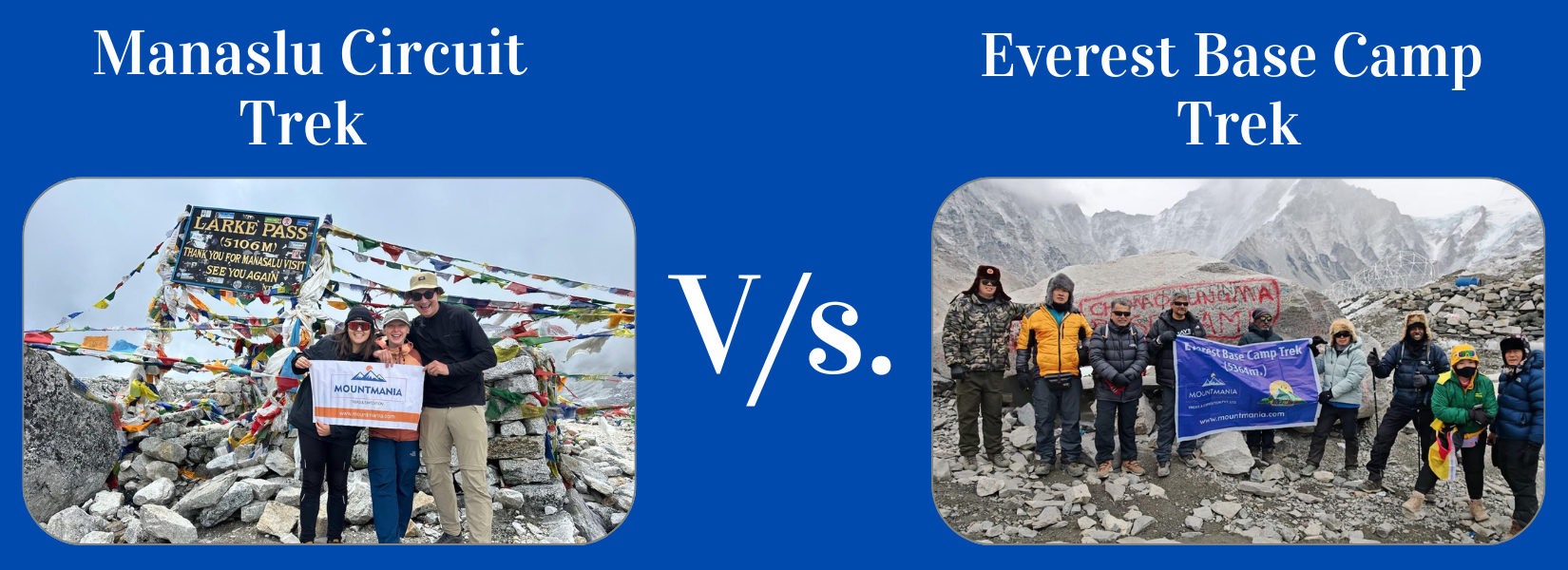
Whether you are an experienced trekker planning your next big challenge or a first-timer trying to gauge what you are getting into, this comprehensive guide breaks down the Manaslu Circuit Trek vs Everest Base Camp difficulty across every factor that matters: altitude, terrain, duration, fitness demands, infrastructure, and more.
Let's dive in.
Overview of Both Treks
Manaslu Circuit Trek

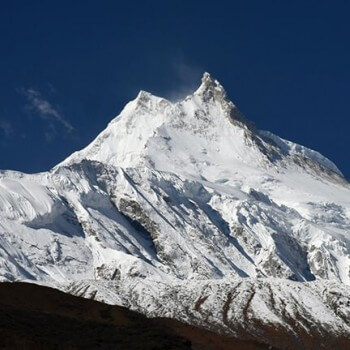
The Manaslu Circuit circumnavigates Mount Manaslu (8,163 m) — the world's eighth-highest peak — in the remote Gorkha district of northwest Nepal. The circuit is one of Nepal's most stunning and least-commercialised treks, passing through lush river valleys, high-altitude forests, traditional Tibetan-influenced villages, Buddhist monasteries, and dramatic mountain landscapes.
- Location: Gorkha District, Gandaki Province, northwest Nepal
- Duration: Typically 14 to 18 days
- Maximum Altitude: Larkya La Pass — 5,160 m (16,929 ft)
- Distance: Approximately 177 km (110 miles)
- Highlights: Larkya La Pass, Birendra Lake, Tsum Valley side trip, Manaslu Conservation Area, authentic Gurung and Tibetan villages, very few crowds
- Permit Required: Manaslu Restricted Area Permit (RAP) + Manaslu Conservation Area Project (MCAP) permit + Annapurna Conservation Area Project (ACAP) permit
Everest Base Camp Trek

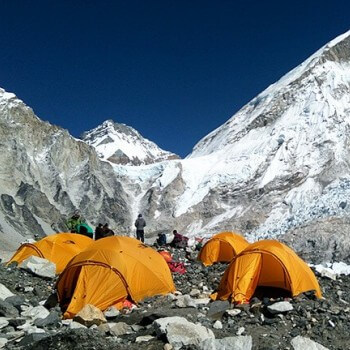
The Everest Base Camp Trek is arguably the world's most iconic trekking route. Starting from Lukla, trekkers follow the Khumbu Valley through Sherpa villages, ancient monasteries, and rhododendron forests before reaching the foot of the world's highest mountain at 5,364 m. It is a trek steeped in history, culture, and a sense of global pilgrimage.
- Location: Khumbu Region, Solukhumbu District, northeast Nepal
- Duration: Typically 12 to 16 days
- Maximum Altitude: Everest Base Camp — 5,364 m (17,598 ft), Kala Patthar — 5,545 m (18,192 ft)
- Distance: Approximately 130 km (81 miles) round trip
- Highlights: Namche Bazaar, Tengboche Monastery, Khumbu Icefall views, Kala Patthar sunrise, Sherpa culture, dramatic Himalayan panoramas
- Permit Required: Sagarmatha National Park Entry Permit + Khumbu Pasang Lhamu Rural Municipality Fee
Difficulty Comparison Factors
Here is a side-by-side overview before we go deeper into each factor:
Factor | Manaslu Circuit Trek | Everest Base Camp Trek |
Max Altitude | 5,160 m (Larkya La Pass) | 5,545 m (Kala Patthar) |
Altitude Sickness Risk | High — rapid gain on final push | High — gradual gain is better managed |
Trail Condition | Remote, rugged, some unmaintained sections | Well-maintained, busy route |
Duration | 14–18 days | 12–16 days |
Daily Walking Hours | 6–9 hours | 5–7 hours |
Fitness Required | High — strong endurance needed | Moderate to High |
Crowds | Very low — restricted permits | Very high — peak season |
Tea House Quality | Basic to moderate | Moderate to excellent |
Medical Facilities | Very limited | Himalayan Rescue Assoc. clinic at Pheriche |
Guide Requirement | Mandatory (Restricted Area) | Recommended but not mandatory |
Overall Difficulty | ★★★★★ More Challenging | ★★★★☆ Challenging |
Altitude & Acclimatization
On paper, the Everest Base Camp route reaches a higher maximum elevation — Kala Patthar at 5,545 m versus Larkya La Pass at 5,160 m on the Manaslu Circuit. However, altitude management is not just about the peak number.
Manaslu Circuit altitude challenge: The approach to Larkya La Pass involves a substantial elevation gain over a short distance, with limited acclimatisation stops in the higher sections of the route. Trekkers often report that the crossing — which typically begins as early as 3 a.m. — is both physically and mentally demanding.
EBC altitude challenge: The Everest Base Camp route is famous for its gradual ascent profile with built-in acclimatisation days at Namche Bazaar (3,440 m) and Dingboche (4,410 m). This well-structured itinerary makes altitude sickness more manageable for the average trekker.
Verdict: EBC has the edge on altitude management. Manaslu's faster elevation gain makes AMS (Acute Mountain Sickness) a greater risk for those who are not well prepared.
Trail Conditions & Terrain
The Manaslu Circuit is remote. Full stop. While conditions have improved slightly with growing trekking interest, significant stretches of the trail remain rugged, steep, and poorly marked. Landslide-prone areas, river crossings, glacial moraine, and high passes test trekkers physically and psychologically.
The EBC trail is one of the most walked routes in the Himalayas. Trails are clear, well-signed, and supported by regular porter and yak traffic. While steep in places — particularly on the ascent from Gorak Shep to Base Camp — the terrain rarely surprises experienced hikers.
Verdict: Manaslu Circuit terrain is significantly more challenging, more variable, and far more isolated than the EBC route.
Duration & Daily Walking Hours
The Manaslu Circuit is a longer trek by both distance and daily effort. On standard itineraries, trekkers walk 6 to 9 hours per day — and on Larkya La crossing day, this extends to 8 to 10 hours starting in the pre-dawn hours.
The Everest Base Camp trek typically involves 5 to 7 hours of walking per day, with rest days built in at key acclimatisation points.
Verdict: Manaslu demands greater daily physical output over more days, making cumulative fatigue a more significant factor.
Physical Fitness Requirements
Both treks require solid cardiovascular fitness, strong leg endurance, and mental resilience. However, the Manaslu Circuit raises the bar noticeably. The combination of remote terrain, longer days, fewer rest stops, and the Larkya La crossing means trekkers need a higher baseline of fitness and prior trekking experience.
For EBC, a fit beginner who has trained consistently for three to four months can realistically complete the route. For the Manaslu Circuit, prior high-altitude trekking experience is strongly recommended — ideally one or more treks above 4,000 m.
Verdict: Manaslu Circuit requires greater physical preparation and prior experience.
Accessibility & Infrastructure
This is where the two treks diverge most dramatically.
Everest Base Camp infrastructure: The EBC route is Nepal's best-supported trekking corridor. Namche Bazaar offers ATMs, bakeries, gear shops, wifi, and a Himalayan Rescue Association clinic. Tea houses along the entire route offer hot meals, charging points, and increasingly comfortable rooms. Emergency helicopter rescue is quick and well-coordinated.
Manaslu Circuit infrastructure: Tea houses exist, but quality is inconsistent — particularly above Samagaon. Mobile network coverage is sparse or absent. Medical facilities are minimal. Emergency rescue is available but
takes considerably longer to organise in the restricted area. Food options become limited as you ascend.
Verdict: EBC is substantially better supported. On Manaslu, you must be prepared for genuine remoteness.
Pros and Cons of Each Trek
Manaslu Circuit Trek
PROS | CONS |
Remote and uncrowded | Requires Restricted Area Permit (higher cost) |
Authentic Himalayan experience | Limited medical facilities and emergency support |
Stunning, varied landscapes — valleys to high passes | Harder logistics (mandatory guide, complex permits) |
Tibetan-influenced culture largely untouched by tourism | Tea house quality is inconsistent |
Option to add Tsum Valley side trip | Fewer flight/road options to trailhead |
Strong sense of adventure and achievement | Best suited to experienced trekkers only |
Everest Base Camp Trek
PROS | CONS |
Iconic global trek with proven itineraries | Very crowded during spring and autumn seasons |
Well-supported infrastructure | Commercialisation has changed the character of the route |
Scenic highlights include Khumbu Icefall and Kala Patthar | Higher trekking cost overall (flights, permits, accommodation) |
Access to Sherpa culture and Tengboche Monastery | Little off-the-beaten-path feel in peak season |
Suitable for motivated beginners | Queue-like conditions at popular viewpoints |
Reliable emergency support and rescue | Weather window narrow — peak seasons only |
Which Trek Is Harder? — The Final Verdict
The Manaslu Circuit Trek is generally considered the more challenging of the two.
While Everest Base Camp reaches a higher absolute altitude, the Manaslu Circuit presents a harder overall experience for the following reasons:
- Greater remoteness — limited support, infrastructure, and rescue access
- Longer daily walking hours with more sustained ascent
- More rugged, variable, and technically demanding terrain
- The Larkya La Pass crossing is one of Nepal's most strenuous high-altitude days
- Fewer structured acclimatisation stops
- Mandatory guide requirement adds a layer of logistical complexity
That said, the Everest Base Camp trek is far from easy. It is a serious high-altitude undertaking that demands genuine fitness, respect for altitude sickness, and careful preparation. For first-time Himalayan trekkers, it remains a challenging and rewarding goal.
In simple terms: if EBC is a 4-star difficulty, Manaslu Circuit is a 5-star. Both deserve full respect — but Manaslu raises the bar on every metric that separates adventure from comfort.
Who Should Choose Which Trek?
Trekker Type | Best Choice | Why |
First-time trekker | Everest Base Camp | Better infrastructure and more forgiving itinerary |
Experienced high-altitude trekker | Manaslu Circuit | Greater challenge and unmatched authenticity |
Budget traveller | Manaslu Circuit (lower permit fees on some seasons) or EBC | Both have similar costs; Manaslu permits add up but accommodation is cheaper |
Luxury trekker | Everest Base Camp | More upscale lodges and facilities available |
Crowd avoider / solo adventurer | Manaslu Circuit | Far fewer trekkers due to permit restrictions |
Cultural immersion seeker | Manaslu Circuit | Untouched Tibetan and Gurung communities |
Wildlife and nature lover | Manaslu Circuit | Manaslu Conservation Area is extraordinarily biodiverse |
Iconic achievement seeker | Everest Base Camp | Few goals rival standing at the foot of Everest |
Tips for Preparing for Either Trek
Fitness Training (Start at Least 3 Months Before)
- Cardiovascular training: running, cycling, swimming — 4 to 5 days a week
- Strength training: focus on legs, core, and back for load-carrying
- Stair climbing with a loaded pack — the single most specific preparation
- Weekend hikes with elevation gain to build real-world acclimatisation
- For Manaslu: aim for at least one prior trek above 4,000 m
Packing Essentials
- Down jacket and layering system — temperatures drop sharply above 4,000 m
- Waterproof outer shell — weather is unpredictable in both regions
- Quality trekking boots — broken in before departure
- Trekking poles — essential for descent on both routes
- Headlamp with spare batteries (critical for Larkya La pre-dawn start)
- Basic first aid kit including Diamox (consult your doctor) for altitude sickness
- Water purification tablets or filter — especially on Manaslu
- Snacks and energy bars for remote sections
Best Time to Trek
Season | Manaslu Circuit | Everest Base Camp |
Spring (Mar–May) | Excellent — best weather, rhododendrons in bloom | Peak season — excellent views, very crowded |
Summer / Monsoon (Jun–Aug) | Not recommended — trail closures likely | Not recommended — heavy rain and cloud cover |
Autumn (Sep–Nov) | Best season — clear skies, stable weather | Peak season — ideal conditions, very crowded |
Winter (Dec–Feb) | Challenging — Larkya La can be closed by snow | Possible at lower altitudes, cold and risky above |
Permits & Guides
Everest Base Camp: No mandatory guide requirement for independent trekkers. Two permits are required: the Sagarmatha National Park Entry Permit and the Khumbu Pasang Lhamu Rural Municipality Trekking Fee. Both are obtainable in Kathmandu or Namche Bazaar.
Manaslu Circuit: A licensed guide is legally required. Three permits are needed: the Restricted Area Permit (RAP), the Manaslu Conservation Area Permit (MCAP), and the Annapurna Conservation Area Permit (ACAP). The RAP must be obtained through a registered trekking agency. Note: Most of these permits currently require a minimum group of two trekkers — solo trekkers must hire a second member or join a group tour.
Conclusion
Whether the Manaslu Circuit's raw, remote majesty calls to you, or the iconic pull of Everest Base Camp feels like the right first step, our expert team is here to make your Nepal trekking dream a reality.
We offer fully guided, permit-inclusive packages for both treks — designed for safety, cultural depth, and unforgettable memories. Not sure which trek is right for you? Message us in WhatsApp +9779841199435 — we love helping trekkers find the perfect route for their fitness level, schedule, and sense of adventure.