
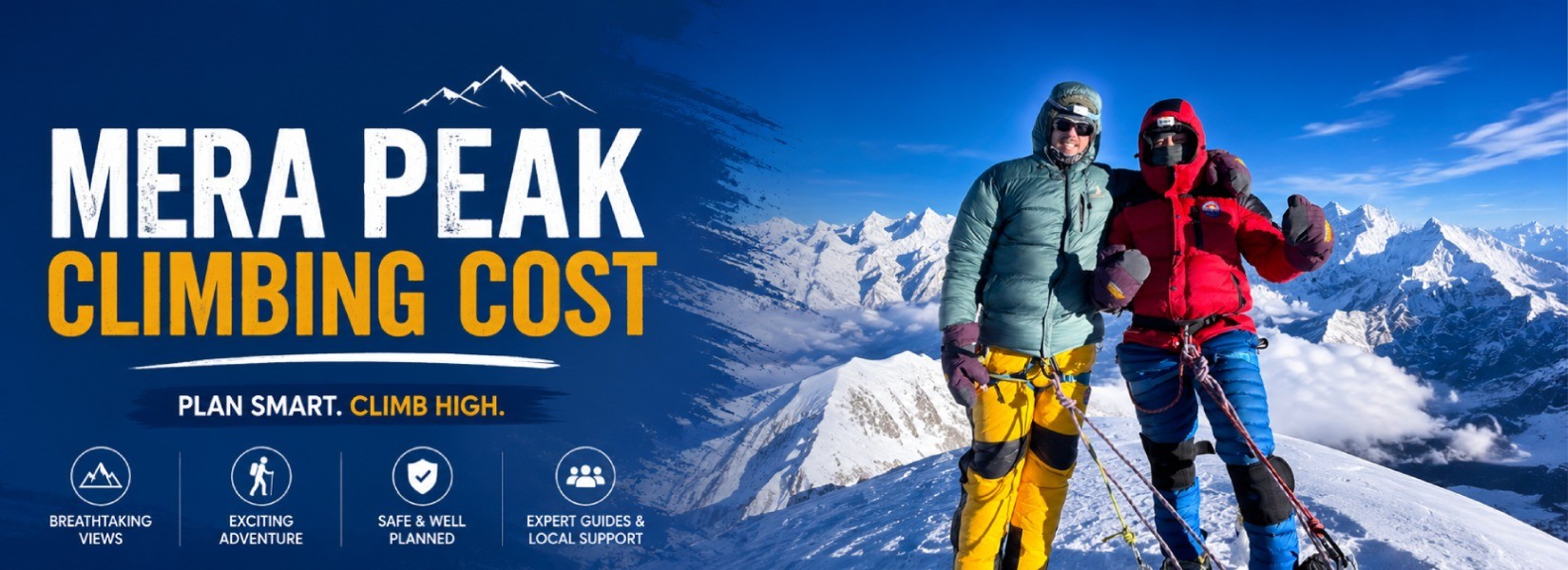
Mera Peak (6,476 m / 21,247 ft) is Nepal's highest trekking peak and one of the most popular Himalayan summits for climbers stepping up from high-altitude trekking into proper mountaineering. The route is non-technical by alpine standards, but it sits well inside serious altitude — and that, more than the climbing itself, is what shapes the cost. If you're planning the trip from Kathmandu, this guide walks through every line item you should expect: permits, logistics, guides, gear, food, insurance, and the hidden extras that catch first-timers off guard.
Table of Contents
Plan your trip to Nepal
Customize your trip with help from a local travel specialist.
Prices below are quoted in US dollars and reflect the 2026 spring and autumn climbing seasons. Most reputable Nepali operators price in USD; budget operators sometimes quote in NPR. Exchange rates fluctuate, so treat these as ranges rather than fixed figures.
Quick Cost Snapshot
Most climbers from Kathmandu end up spending somewhere between USD 2,200 and USD 6,500 for the full expedition, depending heavily on whether you join a group, hire a private guide, or sign up with an international outfitter. Here's how the market generally breaks down:
- Budget Nepali operator (group join): USD 2,200 – USD 2,800
- Mid-range Nepali operator (small group, better logistics): USD 2,800 – USD 3,800
- Premium Nepali operator (private climb, senior Sherpa guide): USD 3,800 – USD 5,000
- International / Western-led expedition: USD 5,500 – USD 9,000+
The wide spread isn't about the mountain — it's about service level, guide-to-client ratio, food quality at high camps, and how much risk and admin the operator absorbs versus passing on to you.
Permits and Government Fees
Permits are non-negotiable and identical regardless of which operator you choose. These are the fixed costs every climber pays.
Mera Peak Climbing Permit (NMA)
- Spring (March – May): USD 350 per person
- Autumn (September – November): USD 175 per person
- Winter / Summer (December – February, June – August): USD 175 per person
Issued by the Nepal Mountaineering Association (NMA). Climbing without it is illegal and will get your operator's licence pulled.
Makalu Barun National Park Entry
NPR 3,000 (approx. USD 23) per person. The standard Mera route crosses into Makalu Barun National Park around Khare and the upper Hinku valley.
Local Rural Municipality Fee
NPR 2,000 (approx. USD 15) per person, collected at Lukla or en route. This replaced the older TIMS card requirement for this region.
Garbage Deposit
USD 250 per team, refundable on proof that waste was carried out. Reputable operators handle this on your behalf and absorb the cost.
Transportation: Kathmandu to Lukla and Back
Almost every Mera Peak itinerary starts and ends with the flight to Lukla, the gateway to the Khumbu and Hinku valleys. This is one of the most variable cost items on the trip.
Lukla Flight
- Kathmandu – Lukla – Kathmandu: USD 250 – USD 260 round-trip (off-peak)
- Ramechhap – Lukla – Ramechhap: USD 180 – USD 200 round-trip (peak season, March–May and September–November)
- Helicopter charter (shared, 5 pax): USD 500 – USD 650 per person one-way
During peak climbing seasons, fixed-wing flights are routed through Ramechhap (a 4–5 hour drive from Kathmandu) because of air-traffic congestion at the capital. Budget operators include the Ramechhap jeep transfer (around USD 25–35 one-way per person); premium operators often default to helicopter to save two days.
Weather Delay Buffer
Build in USD 150 – USD 300 for the very real possibility of being weathered in at Lukla or Kathmandu. Extra nights in Kathmandu, last-minute helicopter upgrades, and rebooking fees all come out of pocket if not covered by your operator's contract.
Guides, Sherpas, and Porters
Labour is the largest single line item in most Mera Peak quotes after international flights. Mera is non-technical but glaciated — a qualified climbing guide is mandatory above Khare, and you'll want porter support for the long approach through the Hinku valley.
- Government-licensed climbing guide (Sherpa): USD 30 – USD 45 per day, typically USD 600 – USD 900 for the full expedition
- Assistant climbing guide (for groups of 4+): USD 25 – USD 35 per day
- Trekking guide for the approach: USD 25 – USD 30 per day
- Porter (carries up to 25 kg): USD 18 – USD 22 per day
- High-altitude porter (above Khare, carries technical loads): USD 30 – USD 40 per day plus climbing kit allowance
Tips
Tipping is customary and effectively part of the cost. Industry norms are around 10–15 percent of the trip price, distributed across the team. Plan for USD 250 – USD 400 in cash (USD or NPR) handed out at the end of the expedition.
Accommodation and Food on the Trail
From Lukla to Khare you sleep in teahouses; above Khare you move into tents at Mera Base Camp (5,300 m) and High Camp (5,800 m). Operators typically bundle this into the package price, but it's useful to know what's actually being paid for.
Teahouses (Lukla to Khare)
- Lodging: NPR 500 – NPR 1,500 per night (USD 4 – USD 12), often free if you eat dinner and breakfast at the same lodge
- Meals: USD 7 – USD 12 per dish at lower elevations, rising to USD 12 – USD 18 above Kothe and Khare
- Hot shower: USD 4 – USD 7
- Wi-Fi (Everest Link / Airlink card): USD 7– USD 15 per day
- Device charging: USD 3 – USD 5 per hour
Base Camp and High Camp
Tented accommodation, kitchen tent, dining tent, and a full mess crew. Per-day operating cost is high — figure USD 80 – USD 130 per climber per day at altitude when you account for food, fuel, oxygen reserves, and crew wages. This is normally rolled into the headline package price.
Kathmandu Hotel
- Budget hotel in Thamel (3-star): USD 30 – USD 45 per night
- Mid-range (4-star, e.g. Hotel Tibet, Aloft, Mulberry): USD 60 – USD 100 per night
- Premium (Hyatt, Marriott, Dwarika's): USD 150 – USD 350 per night
Most packages include 2–3 nights in Kathmandu on a twin-sharing basis. Solo travellers pay a supplement of roughly USD 150 – USD 300 across the trip.
Climbing Gear: Rent or Buy
Mera requires the full mountaineering kit: double boots, crampons, ice axe, harness, helmet, ascender, descender, carabiners, prusiks, and a sleeping bag rated to at least –25°C. Most climbers rent the technical items in Kathmandu rather than fly with them.
Rental Costs in Kathmandu (Thamel)
- Double mountaineering boots (La Sportiva, Scarpa): USD 2 – USD 4 per day
- Down summit suit (–30°C rated): USD 2 – USD 4 per day
- Sleeping bag (–25°C): USD 1 – USD 2 per day
- Crampons, ice axe, harness: USD 1 – USD 2 per day each
- Full technical kit bundle for 18-day expedition: roughly USD 150 – USD 250
Buying Outright
- Genuine branded summit suit: USD 600 – USD 1,200
- Double boots (new): USD 700 – USD 1,000
- Replica gear from Thamel shops: 30–50 percent of branded prices, but quality is inconsistent — fine for a one-off climb, not for ongoing alpine use
If this is your first 6,000 m peak, renting in Kathmandu is almost always the smart call. If you plan to keep climbing — Island Peak, Lobuche, Ama Dablam — investing in your own boots and harness pays off quickly.
Insurance: Don't Cut This Corner
Travel insurance with high-altitude mountaineering coverage and helicopter evacuation up to 6,500 m is the single most important thing you'll buy after the permit. A single helicopter rescue from above Khare runs USD 5,000 – USD 12,000, and the rescue won't lift off until payment or insurance is verified.
Standard travel insurance with mountaineering rider (World Nomads, IMG, Global Rescue): USD 150 – USD 350 for a 3-week policy
Specialist alpinism cover (Austrian Alpine Club, BMC, DAV): USD 80 – USD 150 annual membership including worldwide rescue
Operator-arranged rescue insurance add-on (where offered): USD 50 – USD 100
Read the altitude clause carefully. Many cheap policies cap mountaineering coverage at 4,500 m or 6,000 m — useless for a Mera summit attempt. The policy must explicitly cover technical mountaineering up to 6,500 m, including helicopter evacuation and medical repatriation.
Sample Budget Breakdown (18-Day Itinerary)
Here's how a typical mid-range Mera Peak expedition with a Nepali operator works out for a solo climber joining a small group of 4–6 people in spring 2026:
| Line Item | Cost (USD) |
| Mera Peak climbing permit (spring) | 350 |
| Makalu Barun National Park entry | 23 |
| Local municipality fee | 15 |
| Kathmandu – Lukla – Kathmandu flights | 255x2 |
| Climbing guide (Sherpa, full trip) | 750 |
| Porter (1 shared, 18 days) | 200 |
| Teahouse lodging and meals (Lukla to Khare) | 420 |
Tented camp food and logistics (Base + High Camp) | 650 |
| Kathmandu hotel (3 nights, twin share) | 120 |
| Gear rental (full technical kit) | 200 |
| Insurance (3-week mountaineering policy) | 250 |
| Tips (guides, porters, kitchen crew) | 350 |
| Contingency / weather buffer | 250 |
| Total | 3,708 |
This excludes international flights to Kathmandu, Nepal visa (USD 50 for 30 days), personal gear purchases, alcohol, souvenirs, and any sightseeing day-trips before or after the climb.
Hidden Costs Climbers Forget
Even careful planners get surprised by these. Build a contingency line of USD 300 – USD 500 into your budget specifically for these:
- Excess baggage on the Lukla flight: USD 1.50 per kg over the 15 kg limit
- Single supplement at hotels and teahouses if travelling solo
- Extra acclimatisation nights at Khare if the summit window is poor
- Diamox, antibiotics, and personal medications (USD 30 – USD 60 if bought in Kathmandu)
- Bottled water above Namche (USD 2 – USD 5 per litre) — bring purification tablets instead
- Domestic flight cancellations forcing a helicopter upgrade (USD 500 – USD 700 per person)
- Visa extension if you need extra days in Nepal (USD 3 per day)
- Departure-day taxi to airport, last-minute souvenirs, lounge access
2-Day Mera Peak Base Camp Service from Khare
If you've already trekked to Khare (around 5,000 m) on your own, you don't need a full 18-day package to put yourself on the summit. A growing number of Kathmandu-based operators now sell a stripped-down 2-day Base Camp service from Khare — covering the summit push, gear, and Sherpa support only, with everything below Khare left to you. Mount Mania publishes one of the clearer examples of this format.
What the 2-Day Service Covers
The package is designed for fit, acclimatised trekkers who are already in Khare and want to summit Mera (6,476 m) without booking a full Kathmandu-to-Kathmandu expedition. Typical inclusions:
- Government-licensed Sherpa climbing guide for both days
- Pre-climb briefing and a short training session at Khare (crampons, ice axe, harness, rope work)
- Tented accommodation at Mera High Camp (~5,800 m) with sleeping bag and insulated mattress
- Climbing gear: crampons, ice axe, harness, helmet, ascender, descender, carabiners, fixed-rope hardware
- Meals at High Camp and on summit day
- Group safety kit: supplemental oxygen, oximeter, basic first aid, satellite phone or radio
- Mera Peak climbing permit and Makalu Barun National Park entry arrangement (often paid separately by the climber)
2-Day Itinerary Mera Peak Base Camp Service
Day 1 — Khare (4,950 m) to Mera High Camp (5,800 m): morning briefing and skills refresher, gear check, then a 4–6 hour climb across the moraine and onto the glacier to High Camp. Afternoon rest, hydration, and an early dinner.
Day 2 — Summit push and descent: alpine start around 2:00 a.m., 4–6 hours to the summit, panoramic views of Everest, Lhotse, Makalu, Cho Oyu, and Kangchenjunga, then a long descent back through High Camp to Khare. Expect a 10–12 hour day on summit night.
What the 2-Day Mera Peak Base Camp Service Does Not Cover
- Kathmandu hotel, Kathmandu–Lukla flights, and the multi-day trek in to Khare (Lukla – Paiya – Kothe – Thangnak – Khare)
- Personal trekking and climbing clothing (boots, down jacket, layers, sleeping bag below summit grade)
- Travel and high-altitude mountaineering insurance with helicopter evacuation cover
- Tips for the guide and support staff
- Any rescue, weather delay, or additional acclimatisation nights at Khare
Who This Base Camp Service Package Is For
This format works for independent trekkers who organised their own approach through the Hinku valley, are fully acclimatised after 1–2 nights at Khare, and want professional support only for the technical and high-camp portion of the climb. It is not appropriate for climbers arriving fresh from Lukla — going straight from Khare to High Camp without proper acclimatisation is the single most common cause of altitude sickness on this mountain.
Cost and What to Confirm Before Booking
Pricing is tiered by group size — solo climbers pay a premium, larger groups bring the per-person rate down sharply because the guide and camp costs are shared. Operators publish current rates on their booking pages; Mount Mania's listing for this service is a useful reference point.
- Exact guide-to-client ratio on summit day (1:2 is the safety standard above Khare)
- Whether the climbing permit and park entry are included or charged separately
- What gear is provided versus what you must bring or rent in Kathmandu
- Backup plan and cost structure if weather forces an extra night at High Camp or Khare
- Whether supplemental oxygen is carried by the team and what triggers its use
How to Choose an Peak Climbing Operator
The cheapest quote is rarely the right one. Mera Peak's reputation as an "easy 6,000er" hides genuine altitude risk, and operator quality is what separates a great trip from a dangerous one. Use these filters before signing a contract:
- Government registration: the operator should be registered with NMA and the Department of Tourism. Ask for the licence number.
- Guide-to-client ratio above Khare: ideally 1:2, never worse than 1:3 on summit day.
- Itinerary length: at least 16 days from Kathmandu, with two proper acclimatisation rotations. Anything shorter sacrifices safety for price.
- Inclusions clarity: written list of what's covered (permits, food at altitude, oxygen for emergencies, group climbing equipment) and what isn't.
- Emergency oxygen and a PAC bag (Gamow) carried by the team — not optional.
- Communications: satellite phone or InReach at Base Camp, not just teahouse Wi-Fi.
- References: ask for recent client contacts from the last 12 months, and check independent reviews on TripAdvisor, Trustpilot, and the British Mountaineering Council forum.
Ways to Reduce Cost Without Cutting Safety
- Join a fixed-departure group instead of a private climb — savings of USD 500 – USD 1,500.
- Climb in autumn rather than spring — permit alone is half price (USD 125 vs USD 250).
- Book directly with a Kathmandu-based operator rather than through an overseas re-seller, which adds 30–60 percent margin.
- Rent gear in Thamel rather than buying for a one-off climb.
- Skip the helicopter return unless weather forces it — the savings (USD 500+) are real.
- Bring your own snacks, electrolytes, and protein bars from home — these are heavily marked up at altitude.
- Travel with a partner to split the single-supplement and porter costs.
What not to cut: insurance, guide-to-client ratio, acclimatisation days, and emergency oxygen. Saving USD 200 by trimming one of these is how trips end badly.
Final Word
A realistic all-in budget for a well-run Mera Peak expedition from Kathmandu in 2026 is USD 3,500 – USD 4,500 for a solo climber on a mid-range package, plus international flights and personal gear. You can do it for less than USD 2,500 with a budget operator and tight choices, or spend USD 7,000+ for a premium private climb with one-to-one Sherpa support. Not only that, if you are already at Khare trekking by yourself, then we also have 2 days Mera Peak Climbing Service
Whatever bracket you land in, the cost calculation that matters most isn't dollars per day — it's whether the operator gives you the time, ratio, and equipment to come home safely. Mera is a friendly mountain by Himalayan standards, but it earns every metre of its 6,476. Build the budget around the climb you want, not the one you can technically afford.

Rupak Parajuli
Send an Enquiry
Plan your trip to Nepal
Customize your trip with help from a local travel specialist.